Boron (B) Electron Configuration and Orbital Diagram Model
Boron is the 5th element in the periodic table and the symbol is ‘B’. Boron has an atomic number of 5, which means that its atom has five electrons around its nucleus. To write the electron configuration for boron, the first two electrons will enter the 1s orbital. The next two electrons will enter the 2s orbital and the remaining one electron will enter the 2p subshell. Therefore, the electron configuration of boron will be 1s2 2s2 2p1.
The electron configuration of boron refers to the arrangement of electrons in the boron atom’s orbitals. It describes how electrons are distributed among the various atomic orbitals and energy levels, and provides a detailed map of where each electron is likely to be found.
To understand the mechanism of boron electron configuration, you need to understand two things. These are orbits and orbitals. Also, you can arrange electrons in those two ways. In this article, I have discussed all the necessary points to understand the mechanism of boron electron configuration. I hope this will be helpful in your study.
Electron arrangement for boron through orbit
Scientist Niels Bohr was the first to give an idea of the atom’s orbit. He provided a model of the atom in 1913 and provided a complete idea of orbit in that model.
The electrons of the atom revolve around the nucleus in a certain circular path. These circular paths are called orbits (shells or energy levels). These orbits are expressed by n. [n = 1,2,3,4 . . . The serial number of the orbit]
The name of the first orbit is K, L is the second, M is the third, and N is the name of the fourth orbit. The electron holding capacity of each orbit is 2n2.
| Shell Number (n) | Shell Name | Electrons Holding Capacity (2n2) |
| 1 | K | 2 |
| 2 | L | 8 |
| 3 | M | 18 |
| 4 | N | 32 |
Explanation:
- Let, n = 1 for K orbit. So, the maximum electron holding capacity in the K orbit is 2n2 = 2 × 12 = 2 electrons.
- n = 2, for L orbit. The maximum electron holding capacity in the L orbit is 2n2 = 2 × 22 = 8 electrons.
- n=3 for M orbit. The maximum electron holding capacity in the M orbit is 2n2 = 2 × 32 = 18 electrons.
- n=4 for N orbit. The maximum electron holding capacity in N orbit is 2n2 = 2 × 42 = 32 electrons.
Therefore, the maximum electron holding capacity in the first shell is two, the second shell is eight and the 3rd shell can have a maximum of eighteen electrons.
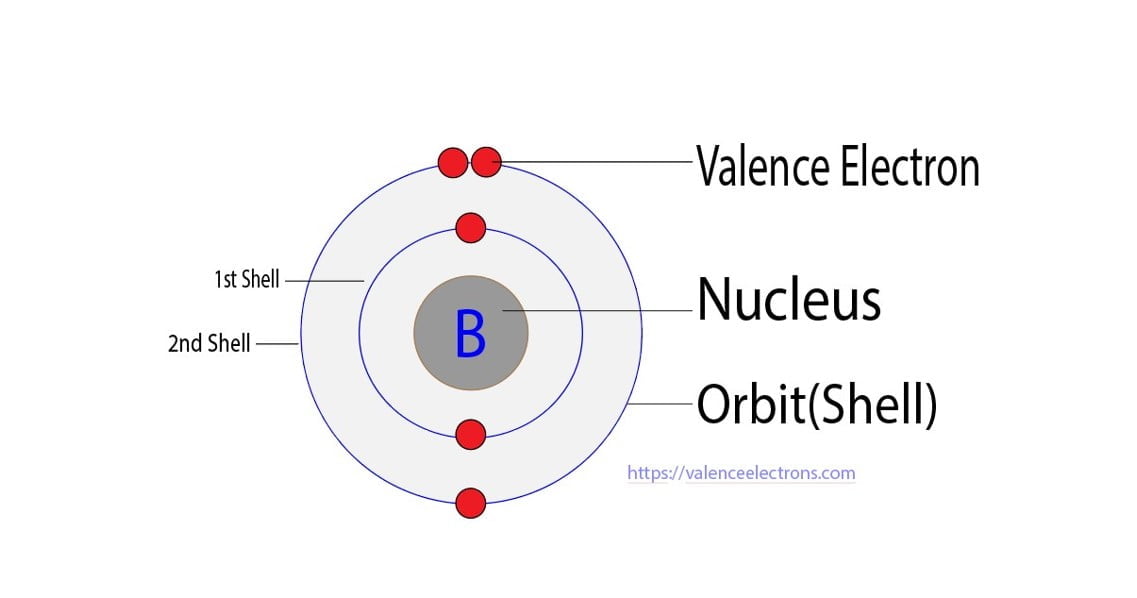
The atomic number is the number of electrons in that element. The atomic number of boron is 5. That is, the number of electrons in boron is 5. Therefore, a boron atom will have two electrons in the first shell and three in the 2nd shell. Therefore, the order of the number of electrons in each shell of the boron(B) atom is 2, 3.
The Bohr atomic model has many limitations. In the Bohr atomic model, the electrons can only be arranged in different shells but the exact position, orbital shape, and spin of the electron cannot be determined.
Also, electrons can be arranged correctly from 1 to 18 elements. The electron arrangement of any element with atomic number greater than 18 cannot be accurately determined by the Bohr atomic model following the 2n2 formula. We can overcome all limitations of the Bohr model following the electron configuration through orbital.
Electron configuration of boron through orbital
Atomic energy shells are subdivided into sub-energy levels. These sub-energy levels are also called orbital. The most probable region of electron rotation around the nucleus is called the orbital.
The sub-energy levels depend on the azimuthal quantum number. It is expressed by ‘l’. The value of ‘l’ is from 0 to (n – 1). The sub-energy levels are known as s, p, d, and f.
| Orbit Number | Value of ‘l’ | Number of subshells | Number of orbitals | Subshell name | Electrons holding capacity | Electron configuration |
| 1 | 0 | 1 | 1 | 1s | 2 | 1s2 |
| 2 | 0 1 | 2 | 1 3 | 2s 2p | 2 6 | 2s2 2p6 |
| 3 | 0 1 2 | 3 | 1 3 5 | 3s 3p 3d | 2 6 10 | 3s2 3p6 3d10 |
| 4 | 0 1 2 3 | 4 | 1 3 5 7 | 4s 4p 4d 4f | 2 6 10 14 | 4s2 4p6 4d10 4f14 |
Explanation:
- If n = 1,
(n – 1) = (1–1) = 0
Therefore, the value of ‘l’ is 0. So, the sub-energy level is 1s. - If n = 2,
(n – 1) = (2–1) = 1.
Therefore, the value of ‘l’ is 0, 1. So, the sub-energy levels are 2s, and 2p. - If n = 3,
(n – 1) = (3–1) = 2.
Therefore, the value of ‘l’ is 0, 1, 2. So, the sub-energy levels are 3s, 3p, and 3d. - If n = 4,
(n – 1) = (4–1) = 3
Therefore, the value of ‘l’ is 0, 1, 2, 3. So, the sub-energy levels are 4s, 4p, 4d, and 4f. - If n = 5,
(n – 1) = (n – 5) = 4.
Therefore, l = 0,1,2,3,4. The number of sub-shells will be 5 but 4s, 4p, 4d, and 4f in these four subshells it is possible to arrange the electrons of all the elements of the periodic table.
| Sub-shell name | Name source | Value of ‘l’ | Value of ‘m’ (0 to ± l) | Number of orbital (2l+1) | Electrons holding capacity 2(2l+1) |
| s | Sharp | 0 | 0 | 1 | 2 |
| p | Principal | 1 | −1, 0, +1 | 3 | 6 |
| d | Diffuse | 2 | −2, −1, 0, +1, +2 | 5 | 10 |
| f | Fundamental | 3 | −3, −2, −1, 0, +1, +2, +3 | 7 | 14 |
The orbital number of the s-subshell is one, three in the p-subshell, five in the d-subshell, and seven in the f-subshell. Each orbital can have a maximum of two electrons.
The sub-energy level ‘s’ can hold a maximum of two electrons, ‘p’ can hold a maximum of six electrons, ‘d’ can hold a maximum of ten electrons, and ‘f’ can hold a maximum of fourteen electrons.
Aufbau is a German word, which means building up. The main proponents of this principle are scientists Niels Bohr and Pauli. The Aufbau method is to do electron configuration through the sub-energy level.
The Aufbau principle is that the electrons present in the atom will first complete the lowest energy orbital and then gradually continue to complete the higher energy orbital.
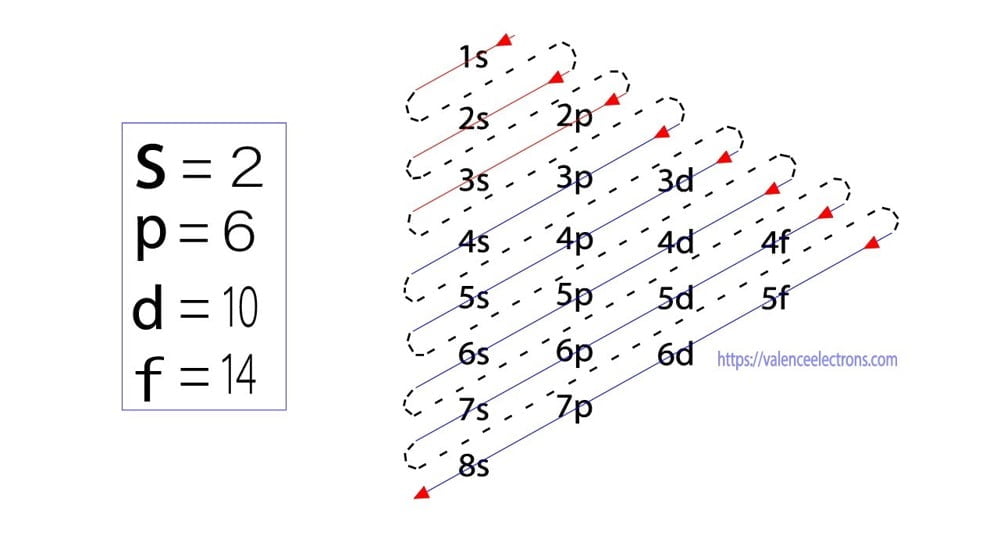
The energy of an orbital is calculated from the value of the principal quantum number ‘n’ and the azimuthal quantum number ‘l’. The orbital for which the value of (n + l) is lower is the low energy orbital and the electron will enter that orbital first.
| Orbital | Orbit (n) | Azimuthal quantum number (l) | Orbital energy (n + l) |
| 3d | 3 | 2 | 5 |
| 4s | 4 | 0 | 4 |
Here, the energy of 4s orbital is less than that of 3d. So, the electron will enter the 4s orbital first and enter the 3d orbital when the 4s orbital is full. Following the Aufbau principle, the sequence of entry of electrons into orbitals is 1s 2s 2p 3s 3p 4s 3d 4p 5s 4d 5p 6s 4f 5d 6p 7s 5f 6d 7p.
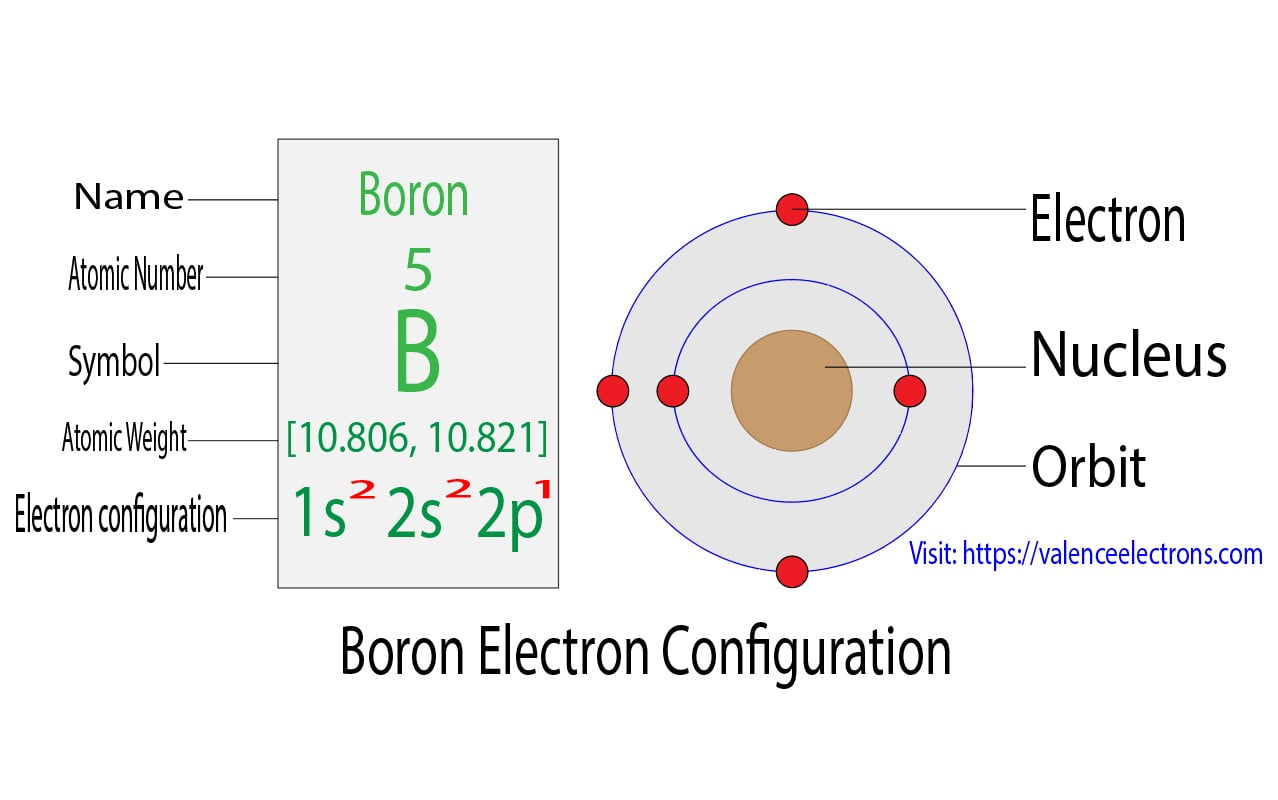
Therefore, the complete electron configuration for boron should be written as 1s2 2s2 2p1.
Note: The unabbreviated electron configuration of boron is [He] 2s2 2p1. When writing an electron configuration, you have to write serially.
How to draw the orbital diagram of boron
The orbital diagram of boron is a graphical representation of the electron configuration of boron atom. This diagram shows how the electrons in the boron atom are arranged in different orbitals and indicates the spin of electrons. Orbital is the region of space around the nucleus of an atom where electrons are found.
To draw an orbital diagram of any atom, you first need to know the atomic orbitals and the orbital notation for that atom, which is already discussed above. Also, you need to know Hund’s and Paul’s exclusion principle. These two fundamental principles explain how these electrons occupy the 1s, 2s, and 2p orbitals. Below, we define each principle and apply it to boron, helping students understand its atomic structure and chemical behavior.
Hund’s Rule
Hund’s Rule states that when electrons fill orbitals of the same energy (degenerate orbitals, like the three 2p orbitals: 2px, 2py, 2pz), they occupy each orbital singly with parallel spins (e.g., all ↑) before pairing up. This arrangement minimizes electron-electron repulsion and maximizes stability.
Pauli Exclusion Principle
The Pauli Exclusion Principle states that no two electrons in an atom can have the same set of four quantum numbers. This means each orbital can hold up to two electrons, and they must have opposite spins (e.g., one ↑ and one ↓).
- Why It Matters: This principle ensures electrons have unique quantum states, defining how orbitals are filled and influencing atomic properties like reactivity.
- Application to Boron: Boron’s five electrons are distributed as follows:
- 1s Orbital: Two electrons occupy the 1s orbital (1s²). They share the same principal quantum number (n=1), angular momentum quantum number (l=0), and magnetic quantum number (m_l=0), but differ in their spin quantum number (m_s=+1/2 for one, m_s=-1/2 for the other), resulting in one ↑ and one ↓.
- 2s Orbital: Two electrons occupy the 2s orbital (2s²). They share quantum numbers (n=2, l=0, m_l=0), but differ in spin (m_s=+1/2 and m_s=-1/2), resulting in one ↑ and one ↓.
- 2p Orbital: The fifth electron occupies one of the 2p orbitals (e.g., 2p_x) alone (2p¹), with quantum numbers (n=2, l=1, m_l=0, m_s=+1/2 or -1/2). Since it’s the only electron in the 2p subshell, no pairing is needed. The Pauli Exclusion Principle ensures each of boron’s electrons has a unique quantum state, allowing the 1s and 2s orbitals to be fully occupied while the 2p subshell has a single electron.
Draw the orbital diagram of boron
Orbital diagrams are usually represented by boxes. Each box represents an orbital and the arrows within the box represent the position of the electron. The boxes are arranged in order of energy of the orbitals. The lowest energy orbitals are closest to the nucleus and the higher energy orbitals are progressively further away from the nucleus in order of their energy levels.
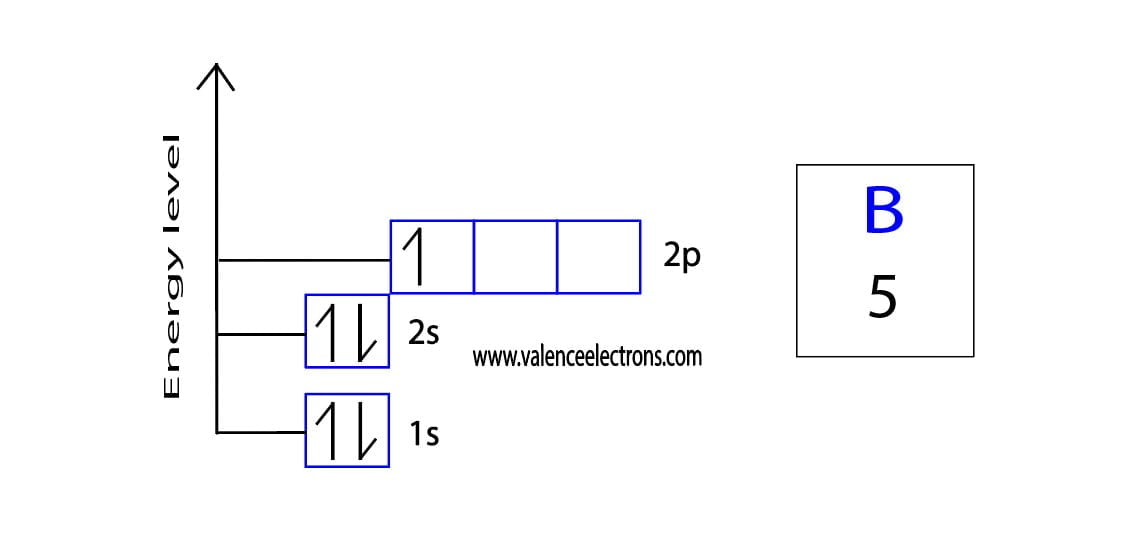
To write the orbital diagram of boron, the 1s orbital is the closest and lowest energy orbital to the nucleus. Therefore, the electrons will first enter the 1s orbital. According to Hund’s principle, the first electron will enter the 1s orbital in the clockwise direction and the second one will enter the 1s orbital in the anti-clockwise direction. The 1s orbital is now filled with two electrons. Then the next two electrons will enter the 2s orbital just like the 1s orbital. The 2s orbital is now full. So the remaining one electron will enter the 2px orbital in the clockwise direction. This is clearly shown in the figure of the orbital diagram of boron.
Why This Matters for Boron
Electron configuration of boron in the excited state
Atoms can jump from one orbital to another in an excited state is called a quantum jump. The ground state electron configuration of boron is 1s2 2s2 2p1. We already know that the p-sub shell has three orbitals. The orbitals are px, py, and pz and each orbital can have a maximum of two electrons. In the boron ground-state electron configuration, an electron of the 3p orbital is located in the px orbital.
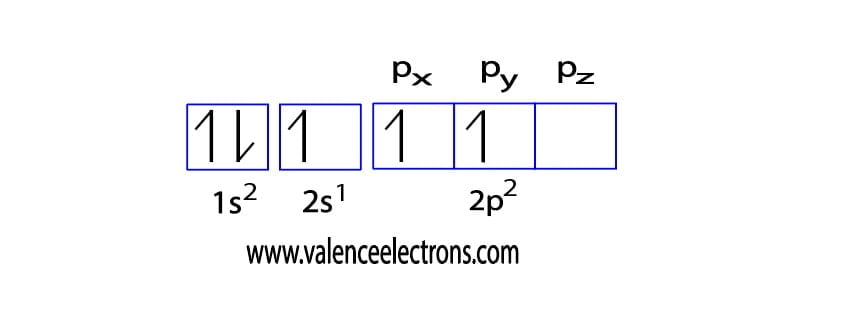
Then correct electron configuration of boron in the ground state will be 1s2 2s2 2px1. When the boron atom is excited, then the boron atom absorbs energy. As a result, an electron in the 2s orbital jumps to the 2py orbital.
So, the electron configuration of boron(B*) in the excited state will be 1s2 2s1 2px1 2py1. The valency of an element is determined by electron configuration in the excited state. Here, boron has three unpaired electrons. Therefore, the valency of boron is 3.
Boron ion(B3+) electron configuration
After the electron configuration, the last shell of the boron atom has three electrons. Therefore, the valence electrons of boron are three. The elements that have 1, 2, or 3 electrons in the last shell donate the electrons in the last shell during bond formation. The boron atom donates three electrons of the last shell to turn into a boron ion(B3+).
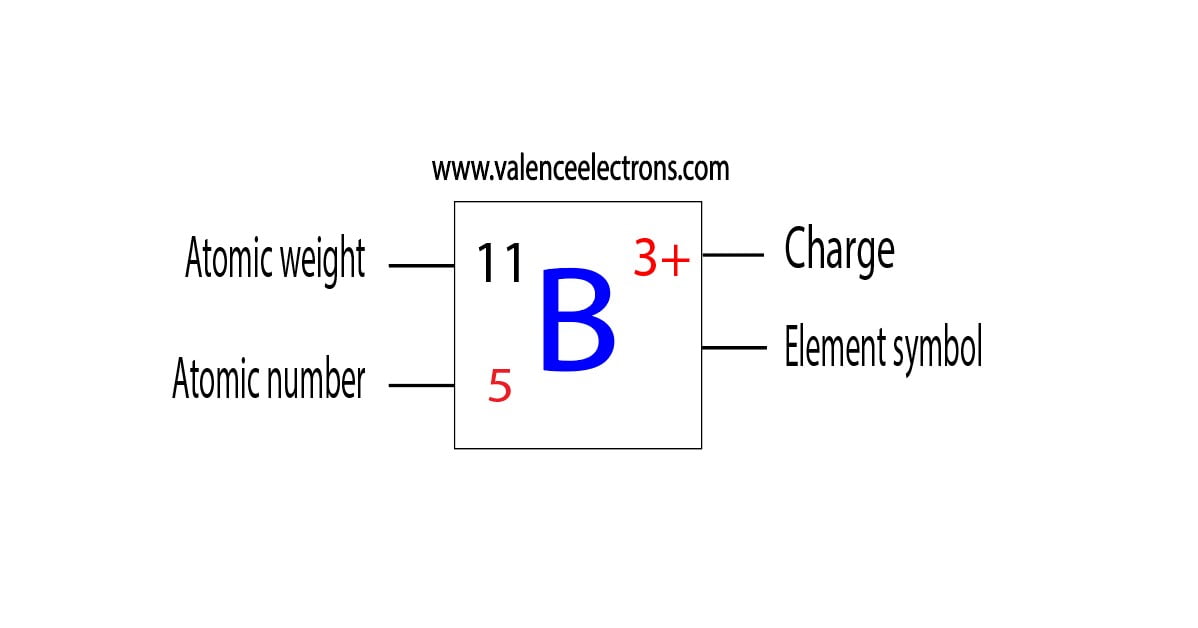
The element that forms a bond by donating electrons is called cation. Boron leaves three electrons and turns into a positive ion. Therefore, boron is a cation element.
B – 3e– → B3+
Here, the electron configuration of boron ion(B3+) is 1s2. This electron configuration shows that the boron ion(B3+) acquired the electron configuration of helium and it achieves a stable electron configuration.
Determine the group and period of boron through the electron configuration
The last orbit of an element is the period of that element. The electron configuration of the boron atom shows that the last orbit of the boron atom is 2. So, the period of boron is 2.
On the other hand, the number of electrons present in the last orbit of an element is the number of groups in that element. But in the case of p-block elements, group diagnosis is different.
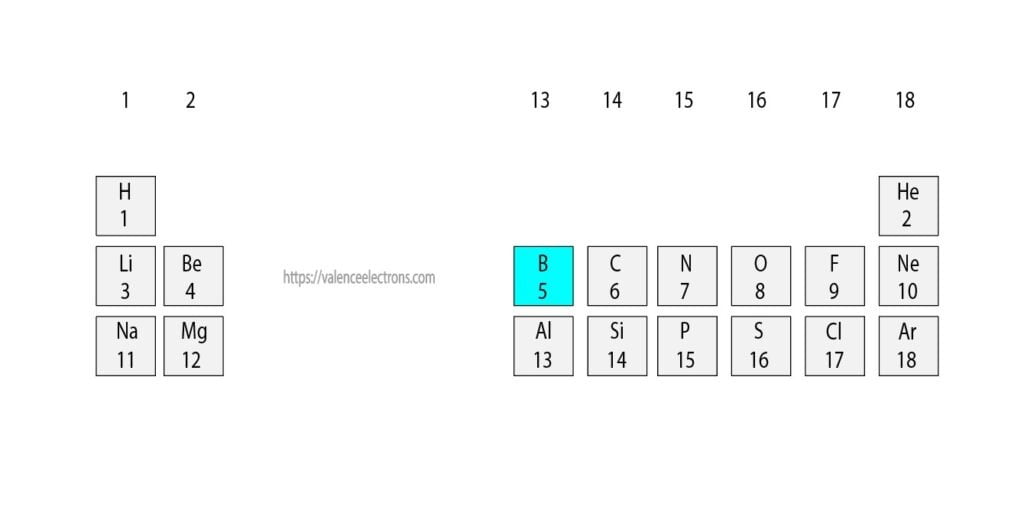
To determine the group of p-block elements, the group has to be determined by adding 10 to the total number of electrons in the last orbit. That is, the group number of boron is 3 + 10 = 13. Therefore, we can say that the period of the boron element is 2 and the group is 13.
Determine the block of boron through the electron configuration
If the last electron enters the p-orbital after the electron configuration of the element, then that element is called the p-block element. The electron configuration shows that the last electron of boron enters the p-orbital. Therefore, boron is the p-block element.
Chemical bonding of boron
Covalent properties of boron atom
The element of group 13 is boron(B). The ion of a boron atom is very small. When boron donates three electrons and turns into a B3+ ion, the value of ionic radius is very low. The cation is much smaller than the size of the positive charge of the nucleus.
In this case, especially in the case of BCl3, the tendency of Cl– ion to attract electrons increases. The B–Cl bond creates more polarity. As a result, covalent properties are revealed in ionic bonds.
Ionic bonds of boron
Boron atoms form ionic bonds by exchanging electrons with chlorine atoms. The electron configuration of the boron indicates that the last orbit of a boron atom has three electrons.
The boron atom wants to be stable like an inert element by leaving three electrons in its last orbit. On the other hand, the last orbit of the chlorine atom has seven electrons.
The chlorine atom wants to be stable by accepting an electron in its last orbit. So, three electrons in the last orbit of the boron atom donate to the chlorine atom.
Both come to a stable state by donating electrons. One boron atom and three chlorine atoms exchange electrons to form the boron trichloride(BCl3) compound through ionic bonding.
Reaction of oxygen
The element of group 13 is boron. Boron reacts with the oxygen atom to form oxide compounds.
4B + 3O2 → 2B2O3.
From the top to the bottom of the group, the acidity of the element decreases, and the alkalinity increases. Boron is the first and most important element in group 13. Therefore, the oxide of the boron atom will be acidic. That is, Di-boron trioxide(B2O3) is an acidic compound.
Reaction of nitrogen
Boron reacts with the nitrogen atom to form nitride compounds.
2B + N2 (heat) → 2BN
The BN and halide compounds produced are covalent and are hydrolyzed to form hydride compounds.
- BN + 3H2O → B(OH)3 + NH3
- BF3 + 3H2O → B(OH)3 + 3HF
- BCl3 + 3H2O → B(OH)3 + 3HCl
- BBr3 + 3H2O → B(OH)3 + 3HBr
- BI3 + 3H2O → B(OH)3 + 3HI
Boron nitride compounds are produced when boron N2 gas is heated to a temperature of about 900°C.
2B + N2 (900 ° C) → 2BN.
Boron nitride is a very slippery solid element. Boron nitride is a permanent structure composed of numerous layers of boron and nitrogen arranged in a balanced hexagonal shape. Its structure is similar to that of graphite.
Reaction with halogen
The element of group 13 is boron. Boron atoms react with halogen to form halide compounds.
- 2B + 3F (heat) → 2 BF3
- 2B + 3Cl (heat) → 2 BCl3
- 2B + 3Br (heat) → 2 BBr3
- 2B + 3I (heat) → 2 BI3
Reaction with water
Boron atoms react with water at 100 ° C to form hydroxide compounds.
2B + 6H2O (100 ° C) → 2B(OH)3 + 3H2
Properties of boron atom
- The atomic number of boron is 5. The atomic number of an element is the number of electrons in that element. Therefore, the number of electrons in the boron is five.
- The standard atomic weight is [10.806, 10.821]
- The period of the boron element is 2 and the group is 13.
- The value of electronegativity of boron atoms is 2.04.
- The covalent radius of the boron atom is 84±3 pm.
- The atomic radius of the boron atom is 87pm.
- Boron atom van der Waals radius 192 pm.
- Ionization energies of boron atoms 1st: 800.6 kJ/mol, 2nd: 2427.1 kJ/mol. 3rd: 3659.7 kJ/mol.
- The oxidation states of boron atoms are +3.
- Boron is a p-block element.
- The melting point of a boron atom is 2349 K (2076 °C, 3769 °F). And the boiling point is 4200 K (3927 °C, 7101 °F).
- The electron addiction value of boron atoms is –27kj mol –1.
- The number of valency and valence electrons of a boron atom is 3.
- Boron forms both covalent and ionic bonds.
- The ionic energy (E) of the boron atom is greater than that of the s-block element.
- 3 electrons exist in the last orbit of the boron.
- Boron is used as a semiconductor.
- Boron conducts heat and is slightly electrically conductive.
Reference
- Schaefer III, H. F., & Harris, F. E. (1968). Electronic structure of atomic boron. Physical Review, 167(1), 67.
- Tai, T. B., Grant, D. J., Nguyen, M. T., & Dixon, D. A. (2010). Thermochemistry and electronic structure of small boron clusters (B n, n= 5− 13) and their anions. The Journal of Physical Chemistry A, 114(2), 994-1007.
- Sergeeva, A. P., Popov, I. A., Piazza, Z. A., Li, W. L., Romanescu, C., Wang, L. S., & Boldyrev, A. I. (2014). Understanding boron through size-selected clusters: structure, chemical bonding, and fluxionality. Accounts of chemical research, 47(4), 1349-1358.

Great explanation of boron’s electron configuration! The orbital diagram really helped clarify how the electrons are arranged. I appreciate the clear visuals and the way you broke down the complex concepts. Keep up the good work!
Great explanation of boron’s electron configuration! I especially appreciated the clear orbital diagram; it really helped me visualize how the electrons are arranged. Thanks for breaking it down so effectively!