How to Write the Electron Configuration for Astatine (At)
Astatine is the 85th element in the periodic table and the symbol is ‘At’. Astatine has an atomic number of 85, which means that its atom has 85 electrons around its nucleus.
To write the electron configuration for astatine, the first two electrons enter the 1s orbital. Since the 1s orbital can hold only two electrons the next two will enter the 2s orbital. The next six electrons enter the 2p subshell. The p subshell can hold a maximum of six electrons. So first we put six electrons in the 2p subshell and then the next two electrons in the 3s orbital.
Since the 3s is now full, the electrons will move to the 3p subshell, where the next six electrons will enter. The 3p subshell is now full. Consequently, the following two electrons will enter the 4s orbital. Since the 4s orbital is full, the next ten electrons will move into the 3d subshell.
The d subshell can hold a maximum of ten electrons. So, the next six electrons will enter the 4p subshell. Since the 4p is full, the next two electrons will move to the 5s orbital. The 5s orbital is now full. Consequently, the next ten electrons will enter the 4d subshell. Since the 4d is full, the next six electrons will enter the 5p subshell.
The 5p subshell is now full. Consequently, the next two electrons will enter the 6s orbital. The 6s orbital is now full. So, the next fourteen electrons will enter the 4f subshell. The f subshell can hold a maximum of fourteen electrons. So, the next ten electrons will enter the 5d subshell. Since the 5d is full, the remaining five electrons will enter the 6p subshell. Hence, the electron configuration of astatine will be 1s2 2s2 2p6 3s2 3p6 4s2 3d10 4p6 5s2 4d10 5p6 6s2 4f14 5d10 6p5.
The electron configuration of astatine refers to the arrangement of electrons in the astatine atom’s orbitals. It describes how electrons are distributed among the various atomic orbitals and energy levels, and provides a detailed map of where each electron is likely to be found.
To understand the mechanism of astatine electron configuration, you must understand two basic things. These are orbits and orbitals. Also, you can arrange electrons in those two ways. In this article, I have discussed all the necessary points to understand the mechanism of astatine electron configuration. I hope this will be helpful in your study.
Electron arrangement of Astatine through the Bohr model
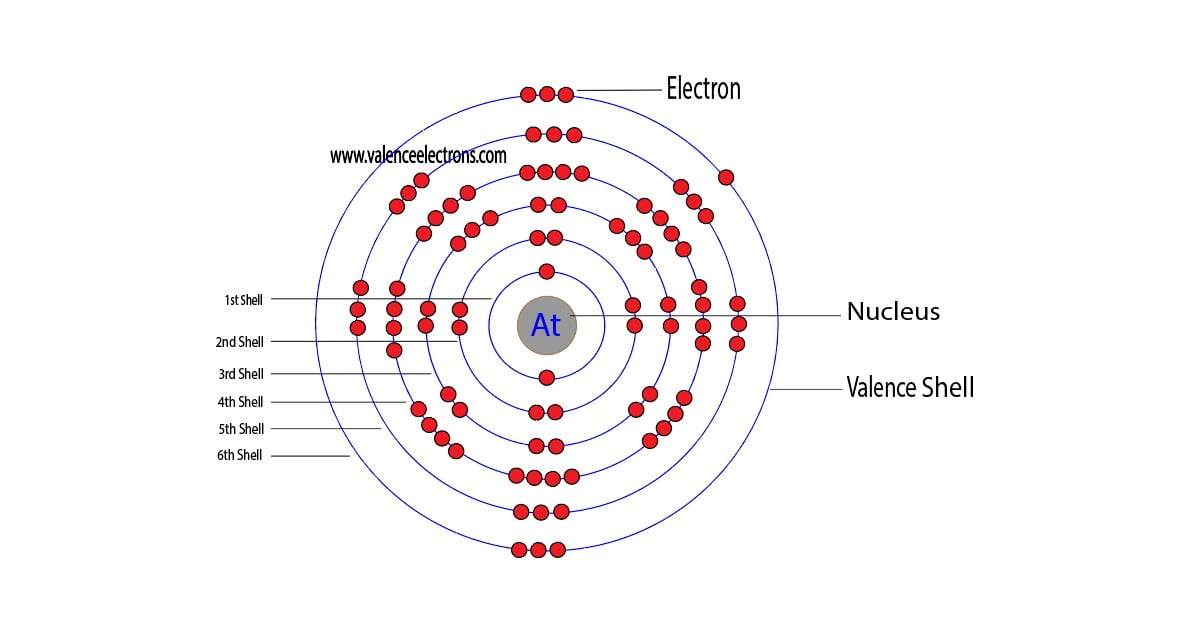
Scientist Niels Bohr was the first to give an idea of the atom’s orbit. He provided a model of the atom in 1913 and provided a complete idea of orbit in that model.
The electrons of the atom revolve around the nucleus in a certain circular path. These circular paths are called orbits (shells or energy levels). These orbits are expressed by n. [n = 1,2,3,4 . . . The serial number of the orbit]
The name of the first orbit is K, L is the second, M is the third, and N is the name of the fourth orbit. The electron holding capacity of each orbit is 2n2.
| Shell Number (n) | Shell Name | Electrons Holding Capacity (2n2) |
| 1 | K | 2 |
| 2 | L | 8 |
| 3 | M | 18 |
| 4 | N | 32 |
Explanation:
- Let, n = 1 for K orbit. So, the maximum electron holding capacity in the K orbit is 2n2 = 2 × 12 = 2 electrons.
- n = 2, for L orbit. The maximum electron holding capacity in the L orbit is 2n2 = 2 × 22 = 8 electrons.
- n=3 for M orbit. The maximum electron holding capacity in the M orbit is 2n2 = 2 × 32 = 18 electrons.
- n=4 for N orbit. The maximum electron holding capacity in N orbit is 2n2 = 2 × 42 = 32 electrons.
Therefore, the maximum electron holding capacity in the first shell is two, the second shell is eight and the 3rd shell can have a maximum of eighteen electrons.
The atomic number is the number of electrons in that element. The atomic number of astatine is 85. That is, the number of electrons in astatine is eighty-five. Therefore, an astatine atom will have two electrons in the first shell, eight in the 2nd orbit, eighteen in the 3rd shell, and thirty-two in the 4th shell.
According to Bohr’s formula, the fifth shell will have twenty-five electrons but the fifth shell of astatine will have eighteen electrons and the remaining seven electrons will be in the sixth shell. Therefore, the order of the number of electrons in each shell of the astatine atom is 2, 8, 18, 32, 18, 7.
The Bohr atomic model has many limitations. In the Bohr atomic model, the electrons can only be arranged in different shells but the exact position, orbital shape, and spin of the electron cannot be determined.
Also, electrons can be arranged correctly from 1 to 18 elements. The electron arrangement of any element with atomic number greater than 18 cannot be accurately determined by the Bohr atomic model following the 2n2 formula. We can overcome all limitations of the Bohr model following the electron configuration through orbital.
Electron configuration of Astatine through orbital
Atomic energy shells are subdivided into sub-energy levels. These sub-energy levels are also called orbital. The most probable region of electron rotation around the nucleus is called the orbital.
The sub-energy levels depend on the azimuthal quantum number. It is expressed by ‘l’. The value of ‘l’ is from 0 to (n – 1). The sub-energy levels are known as s, p, d, and f.
| Orbit Number | Value of ‘l’ | Number of subshells | Number of orbitals | Subshell name | Electrons holding capacity | Electron configuration |
| 1 | 0 | 1 | 1 | 1s | 2 | 1s2 |
| 2 | 0 1 | 2 | 1 3 | 2s 2p | 2 6 | 2s2 2p6 |
| 3 | 0 1 2 | 3 | 1 3 5 | 3s 3p 3d | 2 6 10 | 3s2 3p6 3d10 |
| 4 | 0 1 2 3 | 4 | 1 3 5 7 | 4s 4p 4d 4f | 2 6 10 14 | 4s2 4p6 4d10 4f14 |
Explanation:
- If n = 1,
(n – 1) = (1–1) = 0
Therefore, the value of ‘l’ is 0. So, the sub-energy level is 1s. - If n = 2,
(n – 1) = (2–1) = 1.
Therefore, the value of ‘l’ is 0, 1. So, the sub-energy levels are 2s, and 2p. - If n = 3,
(n – 1) = (3–1) = 2.
Therefore, the value of ‘l’ is 0, 1, 2. So, the sub-energy levels are 3s, 3p, and 3d. - If n = 4,
(n – 1) = (4–1) = 3
Therefore, the value of ‘l’ is 0, 1, 2, 3. So, the sub-energy levels are 4s, 4p, 4d, and 4f. - If n = 5,
(n – 1) = (n – 5) = 4.
Therefore, l = 0,1,2,3,4. The number of sub-shells will be 5 but 4s, 4p, 4d, and 4f in these four subshells it is possible to arrange the electrons of all the elements of the periodic table.
| Sub-shell name | Name source | Value of ‘l’ | Value of ‘m’ (0 to ± l) | Number of orbital (2l+1) | Electrons holding capacity 2(2l+1) |
| s | Sharp | 0 | 0 | 1 | 2 |
| p | Principal | 1 | −1, 0, +1 | 3 | 6 |
| d | Diffuse | 2 | −2, −1, 0, +1, +2 | 5 | 10 |
| f | Fundamental | 3 | −3, −2, −1, 0, +1, +2, +3 | 7 | 14 |
The orbital number of the s-subshell is one, three in the p-subshell, five in the d-subshell, and seven in the f-subshell. Each orbital can have a maximum of two electrons.
The sub-energy level ‘s’ can hold a maximum of two electrons, ‘p’ can hold a maximum of six electrons, ‘d’ can hold a maximum of ten electrons, and ‘f’ can hold a maximum of fourteen electrons.
Aufbau is a German word, which means building up. The main proponents of this principle are scientists Niels Bohr and Pauli. The Aufbau method is to do electron configuration through the sub-energy level.
The Aufbau principle is that the electrons present in the atom will first complete the lowest energy orbital and then gradually continue to complete the higher energy orbital.
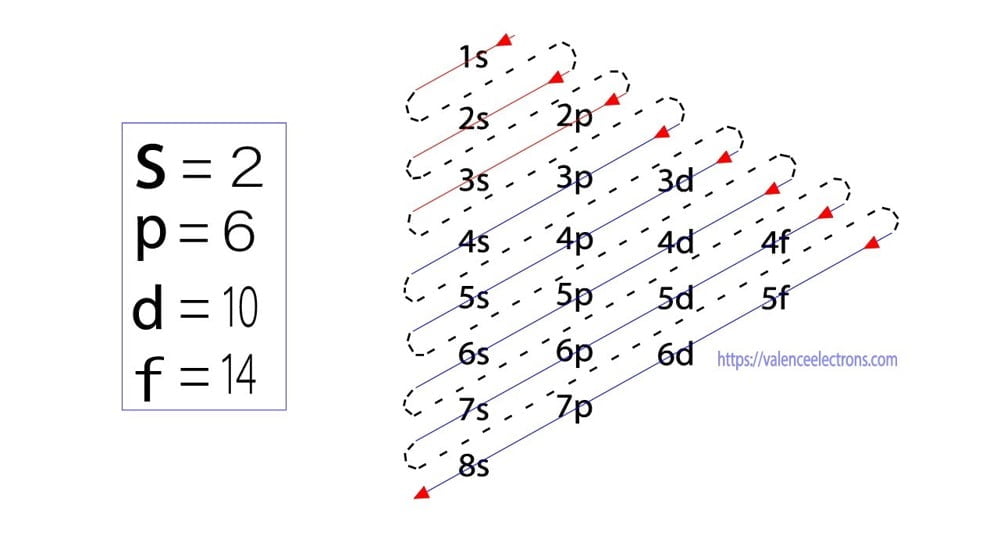
The energy of an orbital is calculated from the value of the principal quantum number ‘n’ and the azimuthal quantum number ‘l’. The orbital for which the value of (n + l) is lower is the low energy orbital and the electron will enter that orbital first.
| Orbital | Orbit (n) | Azimuthal quantum number (l) | Orbital energy (n + l) |
| 3d | 3 | 2 | 5 |
| 4s | 4 | 0 | 4 |
Here, the energy of 4s orbital is less than that of 3d. So, the electron will enter the 4s orbital first and enter the 3d orbital when the 4s orbital is full. Following the Aufbau principle, the sequence of entry of electrons into orbitals is 1s 2s 2p 3s 3p 4s 3d 4p 5s 4d 5p 6s 4f 5d 6p 7s 5f 6d 7p.
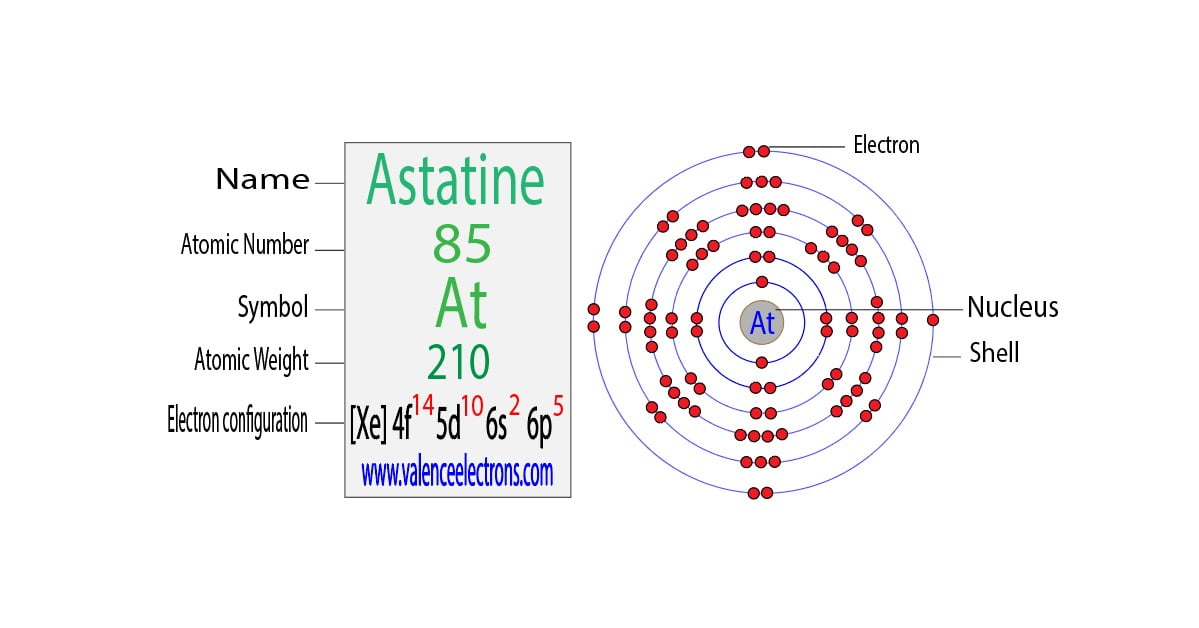
Therefore, the complete electron configuration for astatine should be written as 1s2 2s2 2p6 3s2 3p6 4s2 3d10 4p6 5s2 4d10 5p6 6s2 4f14 5d10 6p5.
Note: The abbreviated electron configuration of astatine is [Xe] 4f14 5d10 6s2 6p5. When writing an electron configuration, you have to write serially.
Astatide ion(At–) electron configuration
The ground-state electron configuration of polonium is 1s2 2s2 2p6 3s2 3p6 3d10 4s2 4p6 4d10 4f14 5s2 5p6 5d10 6s2 6p5. After arranging the electrons, it is seen that the last shell of the astatine atom has seven electrons. Therefore, the valence electrons of astatine are seven.
The elements that have 5, 6, or 7 electrons in the last shell receive the electrons in the last shell during bond formation. The element that receives electrons and forms a bond is called anion. During the formation of bonds, the last shell of astatine receives an electron and turns into an astatide ion(At–). Therefore, astatine is an anion element.
At + e– → At–
Here, the electron configuration of astatide ion(At–) is 1s2 2s2 2p6 3s2 3p6 3d10 4s2 4p6 4d10 4f14 5s2 5p6 5d10 6s2 6p6. This electron configuration shows that the astatide ion(At–) has five shells and the last shell has eight electrons. This electron configuration shows that the astatide ion(At–) has acquired the electron configuration of radon and it achieves a stable electron configuration. Astatine atom exhibits -1,+1,+3,+5,+7 oxidation state. The oxidation state of the element changes depending on the bond formation.
