How Many Valence Electrons Does Copper (Cu) Have?
The 1st element in group 11 is copper and its symbol is ‘Cu’. The elements in groups 3-12 are called transition elements. The valence electrons are the total number of electrons in the last orbit (shell). However, in the case of transition elements, the valence electrons remain in the inner shell.
The total number of electrons in the last shell and d-subshell after the electron configuration of copper is called the valence electrons of copper. The last shell of copper has an electron and the d-subshell has a total of ten electrons. The d-orbital is filled with ten electrons. Therefore, the valence electrons of copper are one.
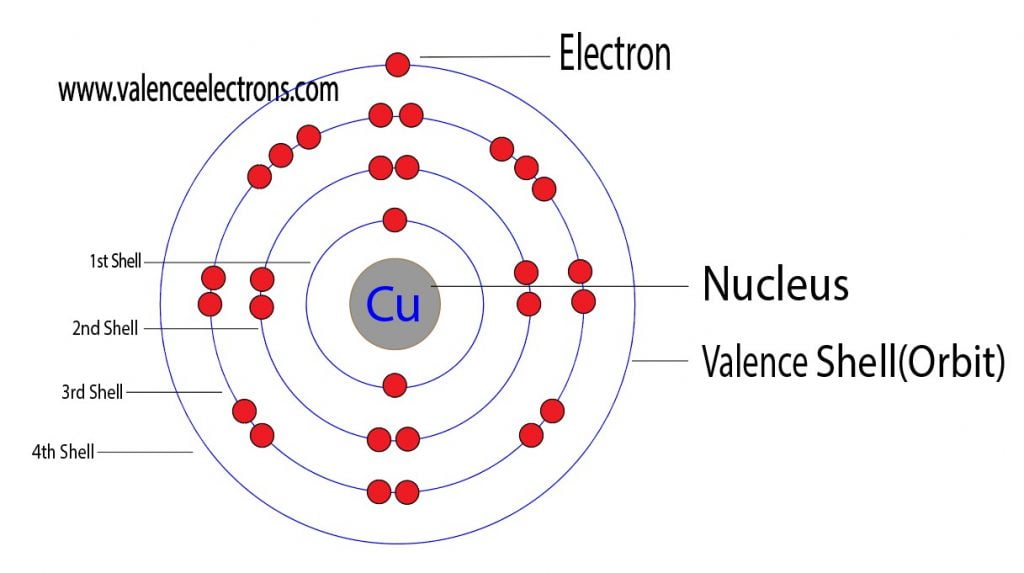
The valence electrons determine the element’s properties and participate in forming bonds. Copper participates in the formation of bonds through its valence electrons. This article discusses how to calculate the number of valence electrons in copper easily. Hopefully, after reading this article you will know in detail about this.
How do you calculate the number of valence electrons in a copper atom?
The valence electrons determine the properties of the element and participate in the formation of bonds. The electrons of the d-orbital participate in the formation of bonds. So, to determine the valence electrons of a transition element, the last shell electrons have to be calculated with the d-orbital electrons.
The valence electrons have to be determined by following a few steps. The electron configuration is one of them. It is not possible to determine the valence electrons without electron configuration. Knowing the electron configuration in the right way, it is very easy to determine the valence electrons of all the elements.
The valence electrons of the transition element cannot be determined according to Bohr’s atomic model. This is because the valence electrons of the transition elements are located in the inner shell. However, the valence electron of the transition element can be easily determined according to the Aufbau principle. Now we will learn how to determine the valence electron of copper.
Step-1: Determining the total number of electrons in copper
1st we need to know the total number of electrons in the copper atom. To know the number of electrons, you need to know the number of protons in copper. To know the number of protons, you need to know the atomic number of the copper element. To know the atomic number we need to take the help of a periodic table.
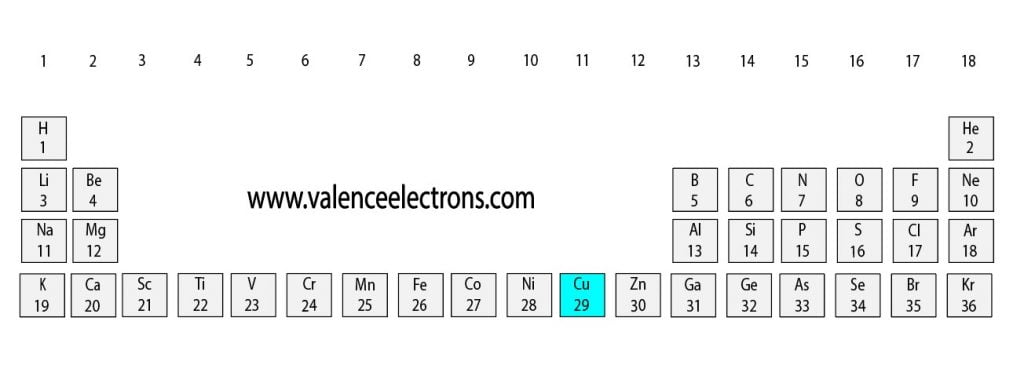
It is necessary to know the atomic number of copper elements from the periodic table. The atomic number is the number of protons. Electrons equal to protons are located outside the nucleus. That is, we can finally say that there are electrons equal to the atomic number in the copper atom. From the periodic table, we see that the atomic number of copper is 29. That is, the copper atom has a total of twenty-nine electrons.
Step-2: Need to do electron configuration of copper
Step 2 is very important. In this step, the electrons of copper have to be arranged. We know that copper atoms have a total of twenty-nine electrons. The first two electrons enter the 1s orbital and the next two electrons enter the 2s orbital. The next six electrons enter the 2p orbital. The p-orbital can have a maximum of six electrons. So, six electrons enter the 2p orbital.
The next eight electrons enter the 3s and 3p orbitals. The 3p orbital is now full, so an electron enters the 4s orbital. We know that a d-orbital can have a maximum of ten electrons. Therefore, the remaining ten electrons enter the d-orbital. Therefore, the copper electron configuration will be 1s2 2s2 2p6 3s2 3p6 4s1 3d10. Here, the d-orbital is filled with electrons.
Step 3: Determine the valence shell and calculate the total electrons
The third step is to diagnose the valence shell. The last shell after the electron configuration is called the valence shell. The total number of electrons in a valence shell is called valence electrons. However, the valence electrons of the transition elements are located in the inner orbit.
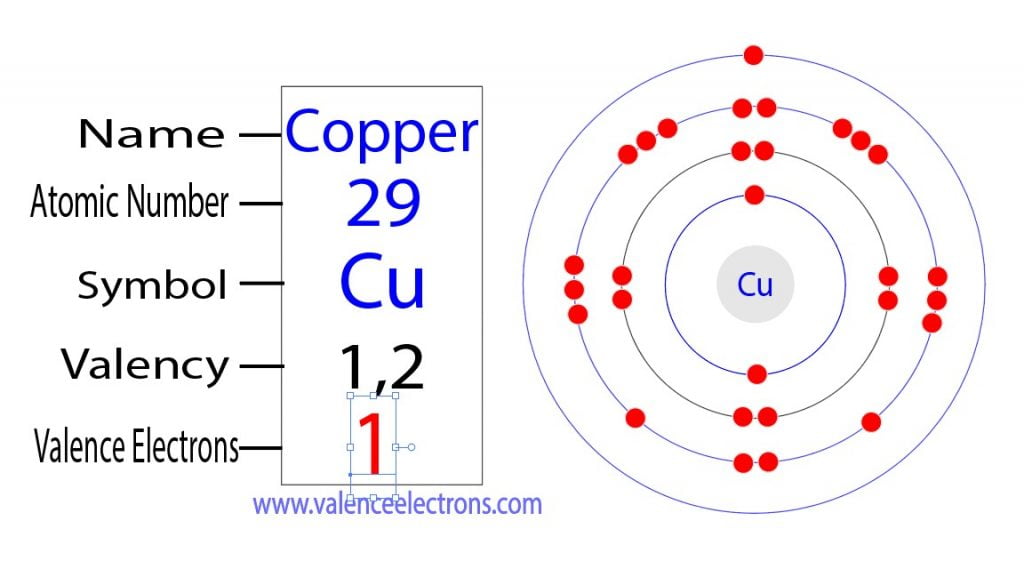
For the transition element, the valence electrons have to be determined by adding the total electrons of the d-orbital to the electron in the last shell of the atom. The last shell of copper has an electron and the d-orbital has a total of ten electrons. Here, the d-orbital is filled with electrons and there is an electron at the last energy shell. Therefore, the valence electrons of copper are one.
How many valence electrons does copper ion(Cu+, Cu2+) have?
The elements that have 1, 2, or 3 electrons in the last shell donate the electrons in the last shell during bond formation. The element that forms a bond by donating electrons is called cation. There are two types of copper ions. The copper atom exhibits Cu+ and Cu+2 ions. The copper atom donates an electron in the 4s orbital to form a copper ion(Cu+).
Cu – e– → Cu+
Here, the electron configuration of copper ion(Cu+) is 1s2 2s2 2p6 3s2 3p6 3d10. The electron configuration of copper ion shows that copper ion(Cu+) has three shells and the last shell has eighteen electrons(3s2 3p6 3d10). For this, copper ion(Cu+) has a total of eighteen valence electrons. Again, the copper atom donates an electron in the 4s orbital and an electron in the 3d orbital to convert copper ion(Cu2+).
Cu – 2e– → Cu2+
Here, the electron configuration of copper ion(Cu2+) is 1s2 2s2 2p6 3s2 3p6 3d9. This electron configuration shows that the copper ion has three shells and the last shell has seventeen electrons. In this case, the valence electrons of the copper ion(Cu2+) are seventeen.
How to determine the valency of copper?
The ability of one atom of an element to join another atom during the formation of a molecule is called valency(valence). There are some rules for diagnosing valency. The number of electrons in an unpaired state in the last orbital after the electron configuration of an atom is called the valency of that element.
The oxidation states of copper are +1 and +2. The oxidation state of copper +1 has been used in the copper(I) oxide(Cu2O). The valency of copper in this compound is 1. On the other hand, The oxidation state of copper +2 has been used in the Copper(II) oxide(CuO). The valency of copper in this compound is 2. The oxidation states of copper depend on the bond formation.
