Lithium Orbital Diagram: Structure, Notation and Explanation
The orbital diagram of lithium is a graphical representation of the electron configuration of a lithium atom. This diagram shows how the electrons in the lithium atom are arranged in different orbitals and indicates the spin of electrons. Orbital is the region of space around the nucleus of an atom where electrons are found.
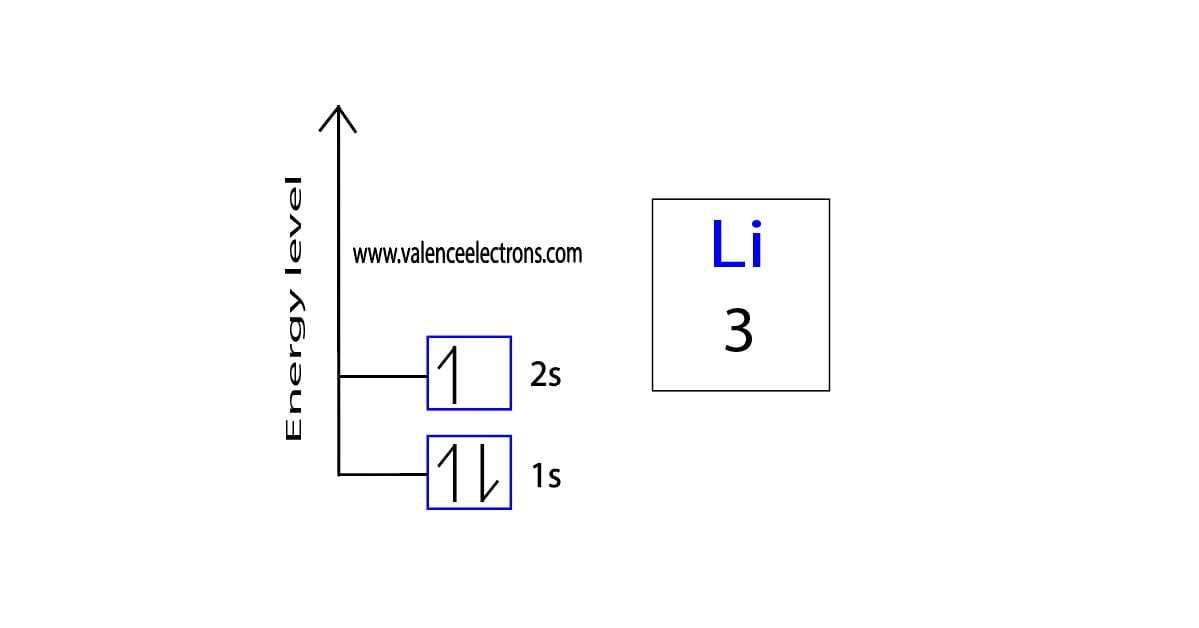
To write the orbital diagram of lithium, the 1s orbital is the closest and lowest energy orbital to the nucleus. Therefore, the electrons will first enter the 1s orbital. According to Hund’s principle, the first electron will enter the 1s orbital in the clockwise direction and the second one will enter the 1s orbital in the anti-clockwise direction. The 1s orbital is now filled with two electrons. So the remaining one electron will enter the 2s orbital in the clockwise direction. This is clearly shown in the figure of the orbital diagram of lithium.
To draw an orbital diagram of any atom, you first need to know the atomic orbitals and the orbital notation for that atom, and also you need to know Hund’s principle.
What is orbital?
The electrons of the atom revolve around the nucleus in certain circular paths. These circular paths are called orbit (shells). Again, atomic energy shells are subdivided into sub-energy levels. These sub-energy levels are also called orbital. The most probable region of electron rotation around the nucleus is called the orbital. The sub-energy levels depend on the azimuthal quantum number. It is expressed by ‘l’.
| Orbit No. | Value of ‘l’ | Number of subshells | Number of orbitals | Subshell |
| 1 | 0 | 1 | 1 | 1s |
| 2 | 0 1 | 2 | 1 3 | 2s 2p |
| 3 | 0 1 2 | 3 | 1 3 5 | 3s 3p 3d |
| 4 | 0 1 2 3 | 4 | 1 3 5 7 | 4s 4p 4d 4f |
Orbital number of the subshell
The value of ‘l’ is from 0 to (n – 1). The sub-energy levels are known as s, p, d, and f. The orbital number of the s-subshell is one, three in the p-subshell, five in the d-subshell, and seven in the f-subshell. Each orbital can have a maximum of two electrons.
| Sub-shell | Value of ‘l’ | Value of ‘m’ (0 to ± l) | Number of orbital (2l+1) | Electrons holding capacity 2(2l+1) |
| s | 0 | 0 | 1 | 2 |
| p | 1 | −1, 0, +1 | 3 | 6 |
| d | 2 | −2, −1, 0, +1, +2 | 5 | 10 |
| f | 3 | −3, −2, −1, 0, +1, +2, +3 | 7 | 14 |
Number of electrons in the orbital
The sub-energy level ‘s’ can hold a maximum of two electrons, ‘p’ can hold a maximum of six electrons, ‘d’ can hold a maximum of ten electrons, and ‘f’ can hold a maximum of fourteen electrons.
What is the orbital notation?
The orbital notation is a shorthand system designed to represent the exact positions of the electrons in an atom. This is similar to electron configuration, but numbers are used instead of boxes to represent the positions of the electrons.
This orbital notation system always follows the Aufbau principle. The Aufbau principle is that the electrons present in the atom will first complete the lowest energy orbital and then gradually continue to complete the higher energy orbital.
The atomic number of lithium is 3, which means it has 3 electrons. Now it is possible to find the orbital notation of lithium very easily through electron configuration. That is, the orbital notation of lithium is 1s2 2s1.
What is Hund’s Principle?
Hund’s principle is a rule that helps to determine how electrons are distributed in orbitals when multiple orbitals of the same energy level are available. Hund’s principle is that electrons in different orbitals with the same energy would be positioned in such a way that they could be in the unpaired state of maximum number and the spin of the unpaired electrons would be one-way.
For example, we already know that the p-subshell has three orbitals. The orbitals are px, py, and pz and each orbital can have a maximum of two electrons. When electrons want to enter the p-subshell, then the first electron will enter the px orbital in the clockwise direction.
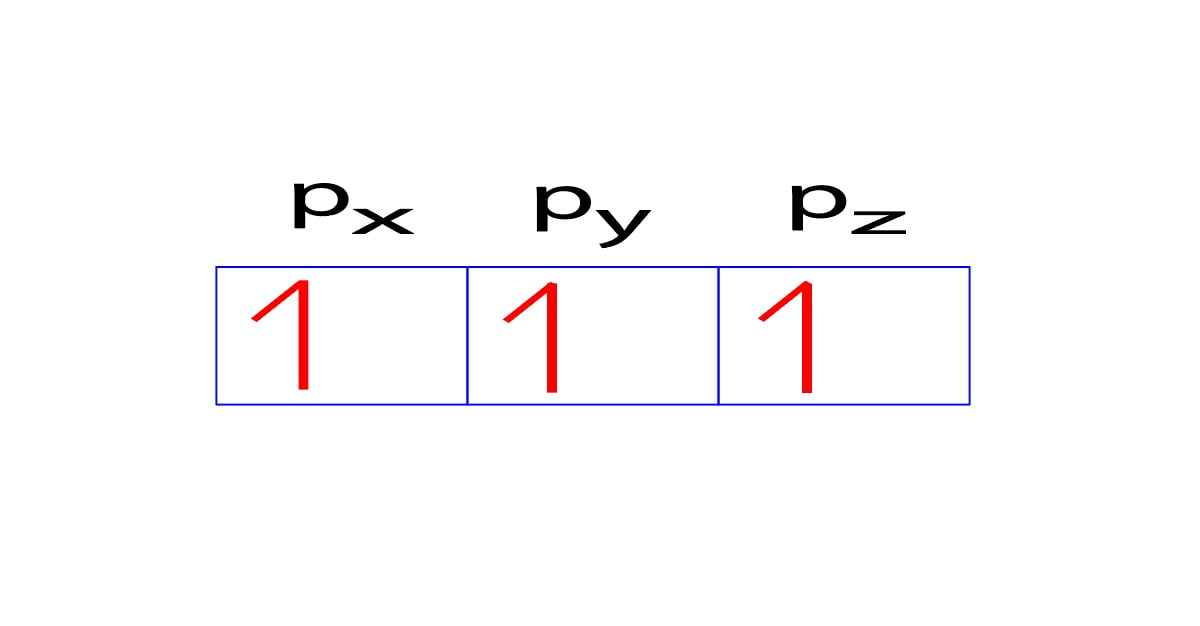
The second electron will also enter the py orbital in the clockwise direction and the third electron will also enter the pz orbital in the clockwise direction. Now, when the fourth electron wants to enter the p-subshell, then it will enter the px orbital in the anti-clockwise direction.
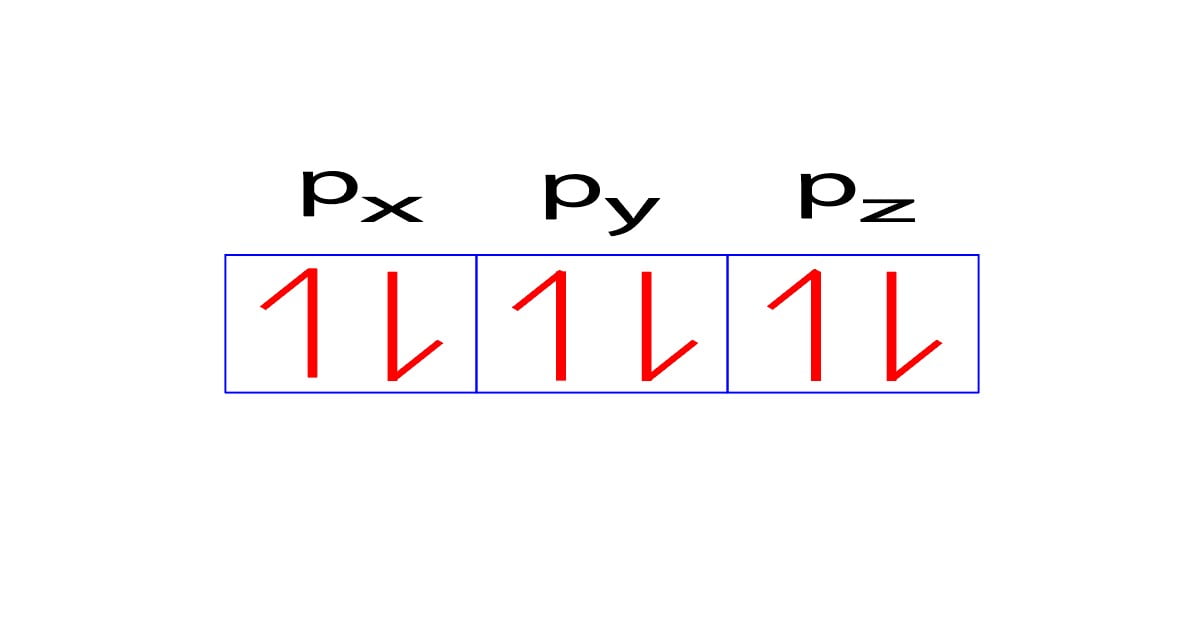
The fifth electron will also enter the py orbital in the anti-clockwise direction and the sixth electron will also enter the pz orbital in the anti-clockwise direction. Here, the clockwise direction is expressed by the upper sign (↑) and the anti-clockwise direction by the lower sign (↓). Basically, these two symbols (↑↓) indicate the direction of electron spin.
How to draw the orbital diagram for lithium?
Orbital diagrams are usually represented by boxes. Each box represents an orbital and the arrows within the box represent the position of the electron. The boxes are arranged in order of energy of the orbitals. The lowest energy orbitals are closest to the nucleus and the higher energy orbitals are progressively further away from the nucleus in order of their energy levels. To draw the orbital diagram of lithium, you have to write the orbital notation of lithium, which has been discussed in detail above.
